Author Archive
Elizabeth Taylor Jewelry Sale at Christie’s
“Her beauty was luxurious. Her eyes just made you melt into her,” said my friend Adam Redfield. He is the son of the late actor William Redfield, who knew Elizabeth Taylor. Adam had the privilege of meeting her once when he was a young man.
She also held the first fundraiser for AIDS research in 1984, recognizing the epidemic and the humanity of victims in the face of prejudice and the silence of Ronald Reagan. This was the moral character of the woman whose jewelry collection sold for $115 million at Christie’s last night.
Her taste and the men who loved her were legendary. Most coveted was the Peregrina Pearl. A 50-carat pearl, it was found by an African slave in the Gulf of Panama. He won his freedom with it. In 1554, Philip II of Spain gave it to his bride, Mary I of England. After her death in 1558, the pearl rejoined the Spanish crown jewels. Elizabeth of Borbón, Queen Consort of Spain and first wife of King Philip IV, was painted wearing the pearl by Diego Velázquez in 1632.
Richard Burton bought it as a Valentine’s Day gift for his wife, Elizabeth Taylor. He paid $37,000 in 1969. She had Cartier set it in a ruby and pearl pendant in 1972. The Peregrina Pearl necklace sold for $11.5 million yesterday at Christie’s.
Richard Burton also bought her the Krupp diamond for $305,000 in 1968. Named for the wife of German industrialist Alfred Krupp, who supplied weapons to Adolf Hitler, Elizabeth Taylor wore it almost every day for the rest of her life because she felt it was justice that a nice Jewish girl should have the ring. It sold for $8,818,500 to Daniel Pang, representing the Korean hotel chain E-Land, which plans to display the ring at its E-World theme park in Daegu.
Here were some other notable sales:
An emerald and diamond necklace by Bulgari: $6,130,500.
The Taj Mahal, a heart-shaped, table-cut Indian diamond from 1628, set by Cartier in a pendant of rubies, jade, and gold: $8,818,500.
A 52-carat Burmese sapphire sautoir, which Bulgari put on a long diamond necklace with geometric sapphire accents, the pendant can also be worn as a brooch. $5,906,500.
The estimates Christie’s put on Elizabeth Taylor’s jewelry were so low, the audience laughed during the auction. Christie’s underestimated her character, but the world did not.
Filed under: Style
Sotheby’s: Louis Comfort Tiffany Auction
In 1902, Louis Comfort Tiffany’s glass studio in Corona, Queens, became known as Tiffany Studios. One of the greatest Art Nouveau designers in the world, Tiffany loved the impurities in cheap jelly jars. He saw color possibilities in the chemistry, which were absent from finer glass.
When he could not convince fine-glass makers to recognize the value of these impurities, he hired English glassblower and chemist Arthur Nash, who invented favrile glass. What Nash managed to do was pour color into molten glass as the impurities were interacting, thereby embedding the color in the glass. Then Tiffany painted with it like Monet. Nash never shared the formula with anyone, and no one has ever been able to reproduce it since.
On December 15, 2011, Sotheby’s is having an auction of the best Tiffany Studios pieces currently on the market. A window has an estimated price of $600,000, a chandelier perhaps $700,000. The final hammer price will be much more. I hope a museum gets at least one of them. Here are some items and their details.
Three-panel magnolia window, exhibited at the Metropolitan Museum of Art, April 12 – September 9, 1990. Estimated price: $400,000 to $600,000.
Trumpet Creeper Chandelier bought by a private owner from the Macklowe Gallery. Estimated price: $500,000 to $700,000.
Poppy lamp with a rare blown glass “Pineapple” base from a Florida collection. Estimated Price: $90,000 to $120,000.
Dragonfly lamp with a rare, early blown glass base from Brooklyn :-). Estimated Price: $70,000 to $90,000.
Filed under: Style
For more scholarly information, please examine
|
|
|
|
|
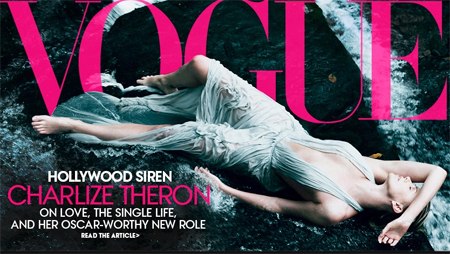
Charlize Theron on the cover of Vogue
Vogue has presented us with one of the most beautiful photographs of the female body and soul I have ever seen. The dress, upside down position, facial expression in a dream is metamorphosis. The rocks and water transform into her. Who photographed Charlize Theron? I knew it when I saw the picture. Annie Liebovitz.
Filed under: Style
Sun Drop Diamond Auction at Sotheby’s
“But soft! What light through yonder window breaks?
It is the East, and Juliet is the sun!
Arise, fair sun, and kill the envious moon
Who is already sick and pale with grief.”
In the play, Mr. Capulet tried to marry his daughter off to the highest bidder, but that didn’t go so well. I have greater hopes for Sotheby’s auction of the biggest yellow diamond in the world, the Sun Drop. Look at the clarity with which it catches dark peach and violet light.
Elizabeth Taylor owned it. It seems while everyone was frothing at the mouth in anticipation of the auction at Christie’s next month, Sotheby’s siphoned off a few choice gems of its own.
Filed under: Style
Elsa Schiaparelli at the Metropolitan Museum
By BarbaraAnne:
On May 10, 2012, the Costume Institute of the Metropolitan Museum of Art will reopen with an exhibition juxtaposing the work of Elsa Schiaparelli and Miuccia Prada.
I have always been familiar with Prada, but discovering Schiaparelli’s designs in the 1930′s was a revelation. She was Coco Chanel’s biggest rival. Chanel called her “that Italian artist who makes clothes.” Influenced by Surrealists like Salvador Dalí, her designs channeled original ideas into exquisite taste. Her personality was flamboyant, as well. She invented the color, “shocking pink,” and unlike Chanel, fled the Nazis to work in New York, raising money for French charities because she refused to design during the war. Her granddaughter is the actress Marisa Berenson.
Here are a few stunning examples of Schiaparelli at the height of her career: Mrs. Reginald (Daisy) Fellowes in 1933, Marlene Dietrich in 1932, the designer herself, golden hair on a jacket sleeve, Dalí painted a lobster on this dress in 1937, dress with roses and two faces, Schiaparelli in her famous shoe hat.
For more scholarly research, please examine
Shocking Life, 1st Edition, by Elsa Schiaparelli
Filed under: Style
Steve Jobs, 1955 – 2011
By BarbaraAnne:
He had no fear.
How many of us give up our dreams to change the world so society won’t think us mad? Is it better to have lost everything following a dream, than having been afraid to try? The latter makes the child inside us cry, forever.
Steve Jobs corrected the mistaken impressions of Don Quixote. He showed us how to live, how to be that girl in the Orwell commercial, who throws the hammer at conformity and introduces the elegant revolution.
He knew he was going to die, so he said…
“Your time is limited, so don’t waste it living someone else’s life. Don’t be trapped by dogma — which is living with the results of other people’s thinking. Don’t let the noise of others’ opinions drown out your own inner voice. And most important, have the courage to follow your heart and intuition. Everything else is secondary.”
“You can’t connect the dots looking forward; you can only connect them looking backwards. So you have to trust that the dots will somehow connect in your future. You have to trust in something.”
“Here’s to the crazy ones, the misfits, the rebels, the troublemakers, the round pegs in the square holes… the ones who see things differently — they’re not fond of rules… You can quote them, disagree with them, glorify or vilify them, but the only thing you can’t do is ignore them because they change things… they push the human race forward, and while some may see them as the crazy ones, we see genius, because the ones who are crazy enough to think that they can change the world, are the ones who do.”
Genius or madness?
Genius.
iThankYou.
Filed under: Angst